Map of North Africa
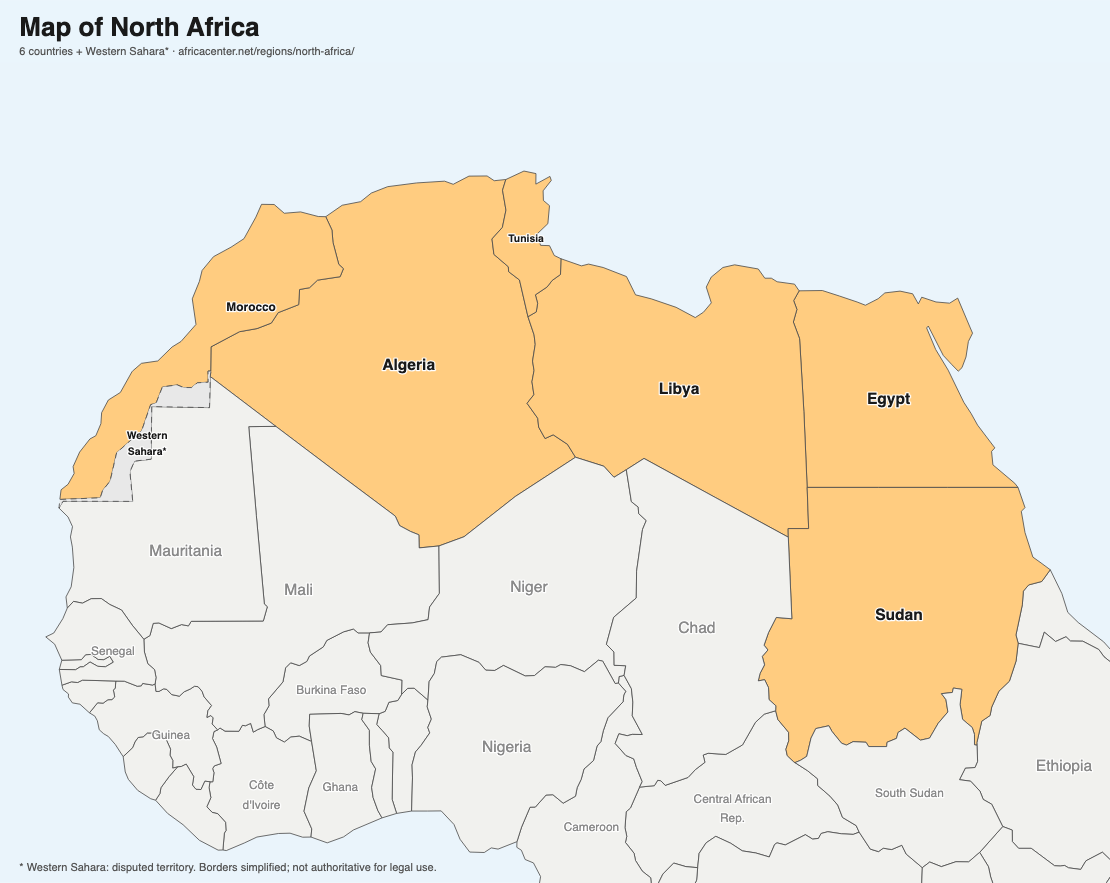
Countries in North Africa
Egypt
Sudan
Algeria
Morocco
Tunisia
Libya
Western Sahara
About North Africa
North Africa is the band of the continent that runs from the Atlantic coast of Morocco eastward to the Red Sea, separated from Europe by the Mediterranean and from the rest of Africa by the southern reaches of the Sahara. The grouping covers Algeria, Egypt, Libya, Morocco, Sudan, Tunisia and the disputed territory of Western Sahara — six recognised states and one non-self-governing territory whose status remains contested at the United Nations.
People and languages
Despite its physical size — most of the regional area is desert — North Africa's population is concentrated along the Mediterranean coast, the Nile Valley, and a thin band of the Atlas Mountains. Cairo is the largest single urban agglomeration in Africa, and the Nile Valley remains one of the highest-density inhabited zones on Earth. Arabic is the dominant first language and shared regional lingua franca, with Berber (Tamazight) co-official in Morocco and Algeria, French and English widely used as second languages, and a small Coptic Christian community in Egypt complementing a Muslim majority.
Economy
Economically, North Africa is the wealthiest region per capita on the continent. Hydrocarbons drive Algeria and Libya, manufacturing and tourism drive Morocco and Tunisia, and Egypt's economy is anchored by Suez Canal traffic, gas, agriculture and a large services sector. The combined nominal GDP of the region is roughly the same as the rest of the continent's coastal economies put together. North African countries are members of the African Union; several are also part of the Arab League and have free-trade arrangements with the European Union.
How to read this regional view
Browse the country profiles below for the indicators we track on each. For methodology — how we reconcile World Bank, IMF and national figures when they disagree — see the methodology. For definitions of indicators such as nominal versus PPP GDP, urbanisation, or literacy, see the glossary.
Last reviewed: 28 April 2026. Figures on the country cards are revised when underlying source organisations publish new releases.